Code
import numpy as np
import pandas as pd
from aggregate import build, Distortion, __version__
from aggregate.spectral import consistent_distortions
from style import wprint, GT, refuse, figures, figure
figures()
print(__version__)2.1.0a5tsallisThe Tsallis distortion, a Beta mixture of TVaRs with a closed-form Gini index, and the extended calibration set
The Tsallis distortion1 of order \(\alpha > 0\) is the mixture of the TVaR distortions \(\min(s/t, 1)\) over the tail probability \(t\), weighted by the Beta\((\alpha, 1)\) density \(\alpha t^{\alpha - 1}\): \[ g_\alpha(s) = \int_0^1 \min(s/t, 1)\,\alpha t^{\alpha-1}\,dt = \frac{\alpha s - s^\alpha}{\alpha - 1}, \] with \(g_1(s) = s(1 - \log s)\) the limit at \(\alpha = 1\). It has no jump at zero, and it puts no weight on the mean or the maximum alone. Its Gini index, \(2\int_0^1 g - 1\) (see Using distortions), is \(1/(\alpha + 1)\), so the member with index \(G\) is \(\alpha = 1/G - 1\). The family runs from the maximum as \(\alpha \to 0\) to the mean as \(\alpha \to \infty\), and \(\alpha = 2\) is the dual distortion \(1 - (1 - s)^2\).
The name comes from the price. Since \(g_\alpha(S) = S + (S - S^\alpha)/(\alpha - 1)\), \[ g_\alpha[X] = \mathsf{P}X + \int_0^\infty \frac{S(x) - S(x)^\alpha}{\alpha - 1}\,dx, \] the expected loss plus the cumulative residual Tsallis entropy of \(X\) of order \(\alpha\). At \(\alpha = 1\) the loading is the cumulative residual entropy \(-\int_0^\infty S \log S\,dx\). The family is used as a sixth pricing family beside the five standard ones. Like them it has one parameter and no jump at zero, and its slope at zero is \(\alpha/(\alpha - 1)\) for \(\alpha > 1\), finite where PH and Wang have an infinite slope.
distortion NAME [as "label"] tsallis alpha
distortion T tsallis 3                          # index 1/4
distortion Half as "Tsallis half" tsallis 0.5 # g(s) = 2 sqrt(s) - s, index 2/3import numpy as np
import pandas as pd
from aggregate import build, Distortion, __version__
from aggregate.spectral import consistent_distortions
from style import wprint, GT, refuse, figures, figure
figures()
print(__version__)2.1.0a5The DecL statement distortion with the kind tsallis builds a Tsallis distortion. In Python the factory Distortion('tsallis', alpha), the static method Distortion.tsallis and the constructor Distortion.from_gini('tsallis', 0.25) build the same object. All four below have the label Tsallis(3), the index 0.25 and the same id.
t = build('distortion T tsallis 3')
for d in [t, Distortion('tsallis', alpha=3.0), Distortion.tsallis(3.0),
          Distortion.from_gini('tsallis', 0.25)]:
    print(f'{type(d).__name__:18s} {d.label:10s} {d.gini:.4f} {d.id()}')
TsallisDistortion Tsallis(3) 0.2500 912DAE9A
TsallisDistortion Tsallis(3) 0.2500 912DAE9A
TsallisDistortion Tsallis(3) 0.2500 912DAE9A
TsallisDistortion Tsallis(3) 0.2500 912DAE9AThe attribute info summarizes the distortion. Its weights mean and weights max rows are both 0, and its TVaR mixture has no atoms inside \((0, 1)\), since the Beta mixture is continuous.
wprint(t.info)distortion object name tsallis
kind tsallis
kind name tsallis (beta(alpha, 1) mixture of tvars)
shape 3
shape name alpha
other params none
weights mean 0
weights max 0
interior atoms False
gini 0.25
area 0.625
id 912DAE9AThe function consistent_distortions(p, extended=True) in aggregate.spectral returns the five standard families and tsallis, all with index \(p\). The table shows \(g(s)\) at five values of \(s\) for index 0.25. At \(s = 0.001\), an event in the extreme tail, only TVaR gives less weight than Tsallis, 0.0013 against 0.0015, and at \(s = 0.5\) Tsallis gives the most, 0.6875. Of the six it is closest to dual, which gives 0.0017 at \(s = 0.001\) and 0.6850 at \(s = 0.5\).
fams = consistent_distortions(0.25, extended=True)
ss = [0.001, 0.01, 0.1, 0.5, 0.9]
GT(pd.DataFrame([[d.gini, d.label, *d.g(np.array(ss))] for d in fams.values()],
                columns=['gini', 'label', *[f'g({x})' for x in ss]],
index=pd.Index(list(fams), name='kind')), float_format='.4f')| kind | gini | label | g(0.001) | g(0.01) | g(0.1) | g(0.5) | g(0.9) |
|---|---|---|---|---|---|---|---|
| ccoc | 0.2500 | ccoc(0.333) | 0.2507 | 0.2575 | 0.3250 | 0.6250 | 0.9250 |
| ph | 0.2500 | PH(0.6) | 0.0158 | 0.0631 | 0.2512 | 0.6598 | 0.9387 |
| wang | 0.2500 | Wang(0.451) | 0.0042 | 0.0303 | 0.2030 | 0.6739 | 0.9584 |
| tsallis | 0.2500 | Tsallis(3) | 0.0015 | 0.0150 | 0.1495 | 0.6875 | 0.9855 |
| dual | 0.2500 | dual(1.67) | 0.0017 | 0.0166 | 0.1610 | 0.6850 | 0.9785 |
| tvar | 0.2500 | TVaR(0.25) | 0.0013 | 0.0133 | 0.1333 | 0.6667 | 1.0000 |
The left panel shows \(g_\alpha\) for six orders, from \(\alpha = 0.25\), index 0.8, to \(\alpha = 7\), index 0.125. The right panel is Distortion.plot for \(\alpha = 3\), which draws \(g\) and its dual \(\check g\).
s = np.linspace(0, 1, 1001)
fig, (ax0, ax1) = figure('full', cols=2)
for alpha in [0.25, 0.5, 1, 2, 3, 7]:
    ax0.plot(s, Distortion.tsallis(alpha).g(s), label=f'alpha = {alpha}')
ax0.plot([0, 1], [0, 1], c='k', lw=0.5)
ax0.set(xlabel='s', ylabel='g(s)', aspect='equal', title='Tsallis distortions')
ax0.legend(fontsize='small')
t.plot(ax=ax1);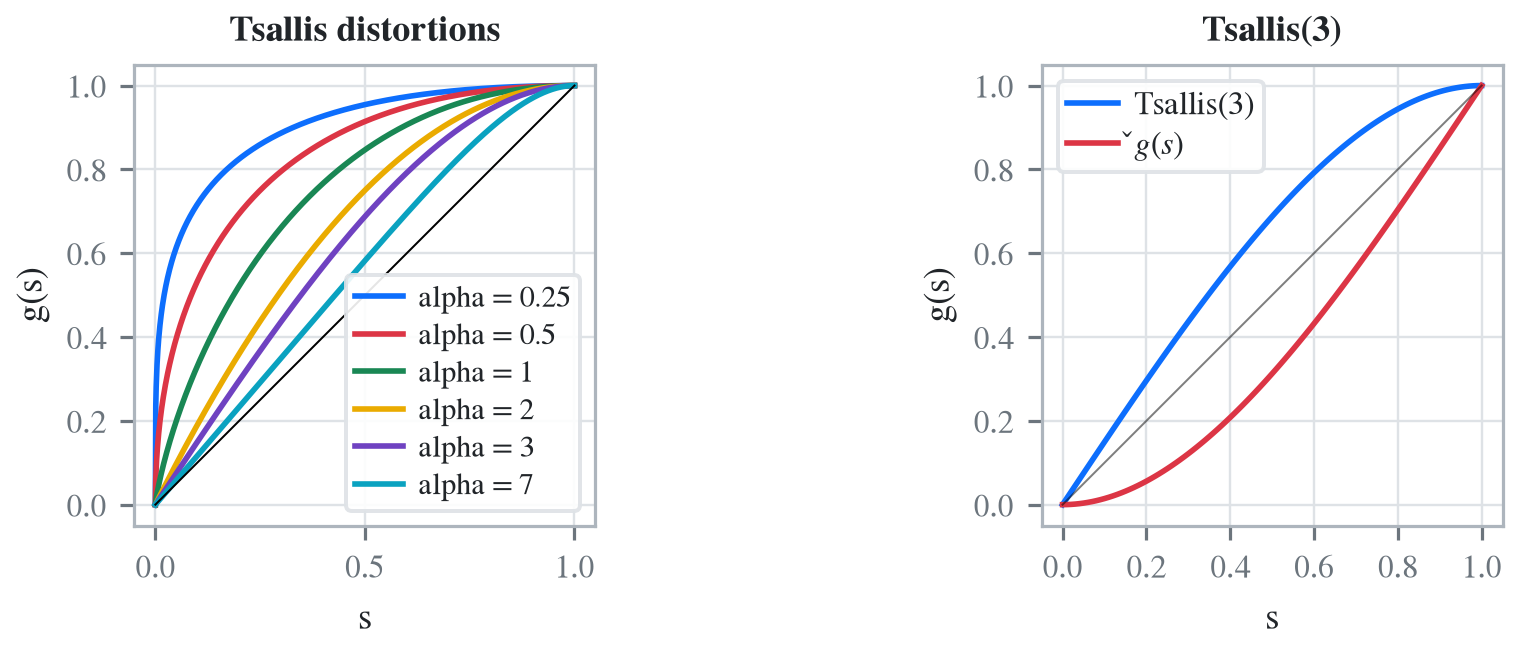
The method calibrate_distortions of an aggregate or a portfolio calibrates the five standard families by default, and with extended=True it adds tsallis between wang and dual. The table shows the six families fitted to a 10% cost of capital at the 99% VaR of a book with 50 expected claims and a lognormal severity with mean 40 and CV 1.8 (see Using price and evaluate for the reverse question). The Tsallis order is solved for in its index, and the fitted \(\alpha = 4.475\) has index 0.183, between dual at 0.175 and TVaR at 0.185. The five standard rows are the same as a default calibration gives.
book = build('agg Book 50 claims sev lognorm 40 cv 1.8 poisson')
res = book.calibrate_distortions(0.1, p=0.99, extended=True)
GT(res.distortion_df[['gini', 'param_name', 'param', 'error']],
formatters={'gini': '{x:.4f}', 'param': '{x:.4g}'})| distortion | gini | param_name | param | error |
|---|---|---|---|---|
| ccoc | 0.0909 | r | 0.1 | 0.00e+00 |
| ph | 0.1392 | a | 0.7555 | 8.88e-10 |
| wang | 0.1581 | lam | 0.2821 | 2.60e-07 |
| tsallis | 0.1826 | alpha | 4.475 | 0.00e+00 |
| dual | 0.1752 | b | 1.425 | -8.71e-09 |
| tvar | 0.1853 | p | 0.1853 | 7.44e-06 |
The price of the book under \(g_1\) is its expected loss plus the cumulative residual entropy \(-\int S \log S\,dx\). Both sides, computed from the survival function of the book on its grid, agree to rounding:
S = book.density_df.S.to_numpy()
el = S.sum() * book.bs
cre = -(S[S > 0] * np.log(S[S > 0])).sum() * book.bs
print(f'g_1[X] = {Distortion.tsallis(1).g(S).sum() * book.bs:,.4f}, '
      f'P X + CRE = {el:,.4f} + {cre:,.4f} = {el + cre:,.4f}')
g_1[X] = 2,566.8986, P X + CRE = 1,999.9998 + 566.8988 = 2,566.8986Four calls are refused: an order that is not positive, a Tsallis distortion with two parameters in DecL, calibrate_distortions with both names and extended=True, which choose the same thing, and Distortion.from_gini with an index outside \((0, 1)\), which no Tsallis distortion reaches.
refuse(lambda: Distortion('tsallis', alpha=0),
       'distortion T tsallis 3 4',
       lambda: book.calibrate_distortions(0.1, p=0.99, names=['ph'], extended=True),
       lambda: Distortion.from_gini('tsallis', 1.0))
TsallisDistortion: alpha must be finite and positive, got 0
DecL distortion 'tsallis' expects 1 parameter(s) ('alpha',), got 2: [3.0, 4.0]
calibrate_distortions takes names= or extended=True, not both: extended=True is
the families ('ccoc', 'ph', 'wang', 'tsallis', 'dual', 'tvar').
from_gini needs a Gini index in the open interval (0, 1), got 1.0.From aggregate 2.1.0a3.↩︎