Code
import numpy as np
import pandas as pd
from aggregate import build, Distortion, __version__
from aggregate.spectral import consistent_distortions
from style import wprint, GT, refuse, figures, figure
figures()
print(__version__)2.1.0a5Distortion functions for risk-adjusted pricing with the DecL distortion statement and the Distortion class
A distortion is an increasing function \(g:[0,1]\to[0,1]\) with \(g(0)=0\) and \(g(1)=1\). It prices a loss \(X \ge 0\) with survival function \(S(x) = \Pr(X > x)\) as \[ g[X] = \int_0^\infty g(S(x))\,dx, \] which is the expected loss \(\mathsf{P}X = \int_0^\infty S(x)\,dx\) when \(g(s) = s\). Square brackets mark \(g\) acting on a random variable, as a spectral risk measure, and parentheses mark \(g\) acting on a probability. A pricing distortion is concave, so \(g(s) \ge s\): it moves probability toward the large losses and \(g[X] \ge \mathsf{P}X\). Its dual \(\check g(s) = 1 - g(1 - s)\) is convex, and \(\check g[X] \le \mathsf{P}X\) is the bid price. Every concave distortion is a mixture of TVaR distortions, so \(g[X]\) is a weighted average of the TVaRs of \(X\) at different levels.
The five families of the standard pricing set each have one shape parameter.
| kind | \(g(s)\) | parameter | \(\mathrm{gini}\) |
|---|---|---|---|
ccoc |
\(d + (1-d)s\) for \(s > 0\) | return \(r\), with \(d = r/(1+r)\) | \(d\) |
ph |
\(s^a\) | \(0 < a \le 1\) | \((1-a)/(1+a)\) |
wang |
\(\Phi(\Phi^{-1}(s) + \lambda)\) | \(\lambda \ge 0\) | \(2\Phi(\lambda/\sqrt{2}) - 1\) |
dual |
\(1 - (1-s)^b\) | \(b \ge 1\) | \((b-1)/(b+1)\) |
tvar |
\(\min(s/(1-p), 1)\) | \(0 \le p \le 1\) | \(p\) |
The constant cost of capital ccoc has a jump of \(d\) at zero, and with assets \(a\) it prices \(X \wedge a\) at \((1-d)\,\mathsf{P}(X \wedge a) + d\,a\), the premium that earns the return \(r\) on the capital. Other important distortions include: tsallis, the Beta\((\alpha, 1)\) mixture of TVaRs, \(g(s) = (\alpha s - s^\alpha)/(\alpha - 1)\), introduced in Using tsallis; bitvar, a mixture of TVaRs at \(p_0 < p_1\) with weight \(w_1\) on \(p_1\); wtdtvar, a weighted TVaR at several levels, built in Python; beta; and cll, clin, lep and ly, which have a second parameter, the intercept r0. The combinators minimum and mixture take other distortions as their arguments.
The index \(\mathrm{gini} = 2\int_0^1 g(s)\,ds - 1\) is twice the area between \(g\) and the diagonal, also equal to twice the margin on a standard uniform. A TVaR at level \(p\) has \(\mathrm{gini} = p\), so the index is the level of the TVaR with the same area. It puts families with incomparable parameters on one scale that increases from 0 for risk neutral to 1 for \(\max{}\) pricing. All the tables of distortions on these pages lead with it. The attribute gini holds the closed form where a family has one and otherwise integrates \(g\) numerically, so every distortion has an index.
distortion NAME [as "label"] kind n1 [n2 ...]
distortion Gentle ph 0.6                         # g(s) = s^0.6
distortion Named as "my distortion" ph 0.6       # the same, with a declared label
distortion Cost ccoc 0.1                         # a 10% return on capital
distortion Two bitvar 0.5 0.99 0.25              # p0, p1, then the weight on p1
distortion Low minimum dist.Gentle dist.Two      # the pointwise minimum
distortion Mix mixture dist.Gentle dist.Two wts [0.6 0.4]
The numbers after the kind are its parameters in a fixed order, and for ccoc the number is the return \(r\). A reference dist.NAME copies a stored distortion into a combinator. An as clause after the name declares the label, and the attribute name stays the family. Pricing with a distortion is the subject of Using price, and finding the distortion that a premium implies is the subject of Using price and evaluate.
import numpy as np
import pandas as pd
from aggregate import build, Distortion, __version__
from aggregate.spectral import consistent_distortions
from style import wprint, GT, refuse, figures, figure
figures()
print(__version__)2.1.0a5The DecL statement distortion returns a Distortion, and the factory Distortion(kind, shape) builds the same object in Python. The shape can also be passed by its natural name: a for ph, lam for wang, b for dual and p for tvar. The static methods Distortion.ph, Distortion.wang and so on are shortcuts. All four forms below give the same distortion, with the same label PH(0.6), the same index 0.25 and the same id.
gentle = build('distortion Gentle ph 0.6')
for d in [gentle, Distortion('ph', 0.6), Distortion('ph', a=0.6), Distortion.ph(0.6)]:
    print(f'{type(d).__name__:14s} {d.label:8s} {d.gini:.4f} {d.id()}')
print(gentle.program)
PHDistortion PH(0.6) 0.2500 E83B5ED9
PHDistortion PH(0.6) 0.2500 E83B5ED9
PHDistortion PH(0.6) 0.2500 E83B5ED9
PHDistortion PH(0.6) 0.2500 E83B5ED9
distortion Gentle ph 0.6An as clause changes the label and leaves the family in name:
named = build('distortion Named as "my distortion" ph 0.6')
print(named.name, '|', named.label, '|', named.program)
ph | my distortion | distortion Named as "my distortion" ph 0.6The shortcut for ccoc takes the return r=, as DecL does, or the discount d=, with \(d = r/(1+r)\), always by keyword. All four forms below give \(d = 1/11\), a 10% return.
print(build('distortion Cost ccoc 0.1').d, Distortion('ccoc', r=0.1).d,
      Distortion.ccoc(r=0.1).d, Distortion.ccoc(d=1 / 11).d)
0.09090909090909091 0.09090909090909091 0.09090909090909091 0.09090909090909091The attribute info summarizes a distortion. Its weights mean and weights max rows are the weights its TVaR mixture puts on the mean (\(p=0\)) and on the maximum (\(p=1\)). A PH distortion puts weight \(a\) on the mean, here 0.6, and none on the maximum; area is \(\int_0^1 g = (1 + \mathrm{gini})/2\).
wprint(gentle.info)distortion object name ph
kind ph
kind name proportional hazard
shape 0.6
shape name a
other params none
weights mean 0.6
weights max 0
interior atoms False
gini 0.25
area 0.625
id E83B5ED9The recipe library included with aggregate (see Using recipes) holds one distortion of each standard family, each with \(\mathrm{gini} = 0.2\), and a minimum and a mixture of two of them. A bare name builds the stored entry. The column 2∫g − 1 is the index computed from \(g\) on a fine grid, and it agrees with gini for all seven. The index is linear in \(g\), so the mixture of two distortions with index 0.2 has index 0.2, and the minimum lies below both and has a smaller index, 0.162.
s = np.linspace(0, 1, 100_001)
lib = {n: build(n) for n in build.discover(kind='distortion', tags='topic:spectral').index}
GT(pd.DataFrame({'gini': [d.gini for d in lib.values()],
                 '2∫g − 1': [2 * np.trapezoid(d.g(s), s) - 1 for d in lib.values()],
                 'label': [d.label for d in lib.values()]},
index=pd.Index(list(lib), name='recipe')))| recipe | gini | 2∫g − 1 | label |
|---|---|---|---|
| CCoCDistortion | 0.2000 | 0.2000 | ccoc(0.25) |
| DualDistortion | 0.2000 | 0.2000 | dual(1.5) |
| MinimumDistortion | 0.1623 | 0.1623 | minimum(2) |
| MixtureDistortion | 0.2000 | 0.2000 | mixture(2) |
| PHDistortion | 0.2000 | 0.2000 | PH(0.667) |
| TVaRDistortion | 0.2000 | 0.2000 | TVaR(0.2) |
| WangDistortion | 0.2000 | 0.2000 | Wang(0.358) |
The function consistent_distortions(p) in aggregate.spectral returns one distortion of each standard family, all with \(\mathrm{gini} = p\). They enclose the same area and differ in where they put it. The table shows \(g(s)\) at five values of \(s\). At \(s = 0.001\), an event in the extreme tail, ccoc gives weight 0.251 and PH 0.016, while dual and TVaR give less than 0.002. At \(s = 0.5\) ccoc gives the least weight, 0.625, and dual the most, 0.685. For the same index, the tail-heavy families ccoc and PH load a rare large loss more heavily, and dual and TVaR load the body of the distribution.
fams = consistent_distortions(0.25)
ss = [0.001, 0.01, 0.1, 0.5, 0.9]
GT(pd.DataFrame([[d.gini, d.label, *d.g(np.array(ss))] for d in fams.values()],
                columns=['gini', 'label', *[f'g({x})' for x in ss]],
index=pd.Index(list(fams), name='kind')))| kind | gini | label | g(0.001) | g(0.01) | g(0.1) | g(0.5) | g(0.9) |
|---|---|---|---|---|---|---|---|
| ccoc | 0.2500 | ccoc(0.333) | 0.2507 | 0.2575 | 0.3250 | 0.6250 | 0.9250 |
| ph | 0.2500 | PH(0.6) | 0.0158 | 0.0631 | 0.2512 | 0.6598 | 0.9387 |
| wang | 0.2500 | Wang(0.451) | 0.0042 | 0.0303 | 0.2030 | 0.6739 | 0.9584 |
| dual | 0.2500 | dual(1.67) | 0.0017 | 0.0166 | 0.1610 | 0.6850 | 0.9785 |
| tvar | 0.2500 | TVaR(0.25) | 0.0013 | 0.0133 | 0.1333 | 0.6667 | 1.0000 |
The constructor Distortion.from_gini(kind, gini) builds the member of a one-parameter family with a given index, for ccoc, ph, wang, tsallis, dual and tvar, and consistent_distortions uses the same inverses. Each distortion below has index 0.25:
for kind in ['ph', 'wang', 'tsallis', 'dual']:
    d = Distortion.from_gini(kind, 0.25)
    print(f'{d.label:12s} {d.gini:.6f}')
PH(0.6) 0.250000
Wang(0.451) 0.250000
Tsallis(3) 0.250000
dual(1.67) 0.250000The left panel shows the five distortions with \(\mathrm{gini} = 0.25\). The ccoc line starts at \(d = 0.25\), the jump at zero, and TVaR reaches 1 at \(s = 1 - p = 0.75\). The right panel is Distortion.plot, which draws \(g\) and, by default, its dual \(\check g\), on axes of equal length, since the concavity of \(g\) is what the plot is for.
fig, (ax0, ax1) = figure('full', cols=2)
for d in fams.values():
    ax0.plot(s, d.g(s), label=d.label)
ax0.plot([0, 1], [0, 1], c='k', lw=0.5)
ax0.set(xlabel='s', ylabel='g(s)', aspect='equal', title='gini = 0.25')
ax0.legend(fontsize='small')
gentle.plot(ax=ax1);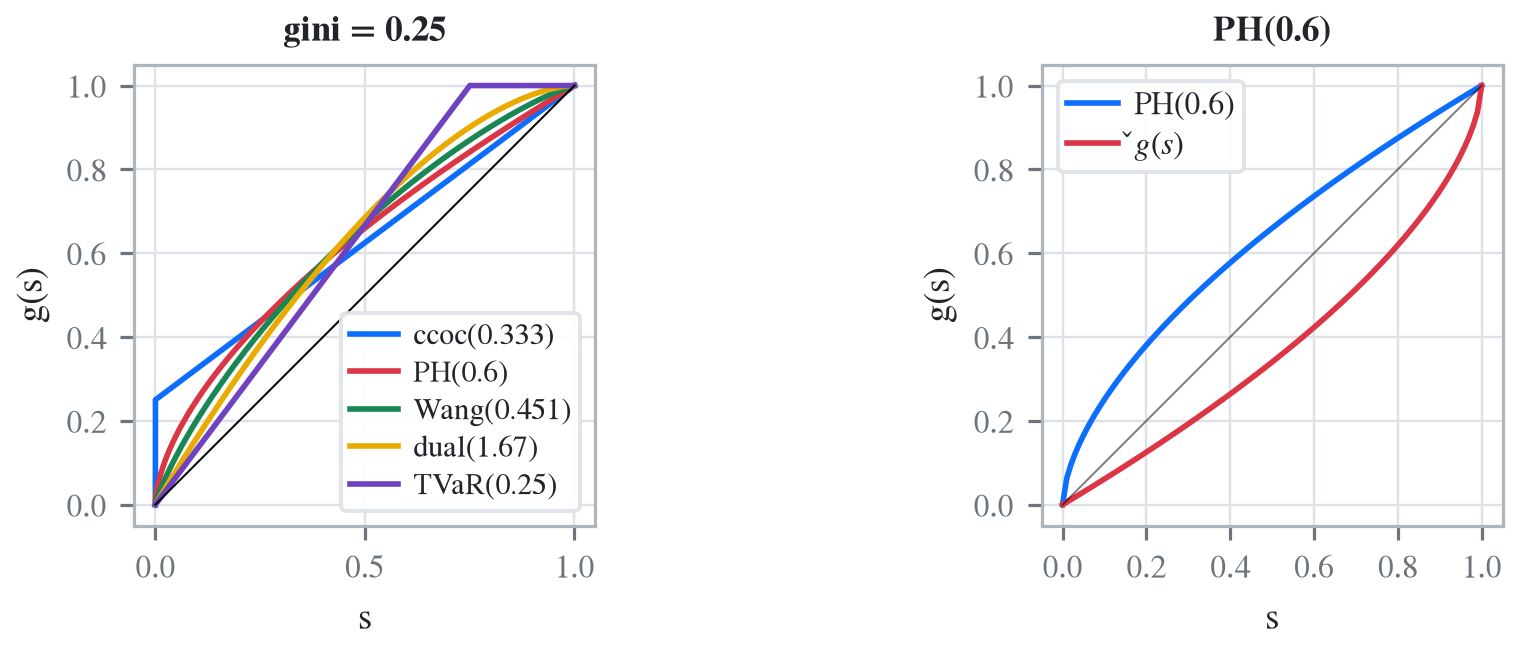
Four distortion programs are refused: wtdtvar, which has no DecL form because its parameters are vectors; a ph with two parameters; a bitvar with \(p_0 > p_1\); and a kind that does not exist. The last message lists the available kinds. In Python, Distortion.ccoc refuses a bare number, which could be either the return or the discount, and Distortion.from_gini refuses a family with more than one parameter, listing its parameters.
refuse('distortion W wtdtvar 0.5 0.9',
       'distortion P ph 0.6 0.7',
       'distortion B bitvar 0.9 0.5 0.5',
       'distortion X expo 0.5',
       lambda: Distortion.ccoc(0.1),
       lambda: Distortion.from_gini('bitvar', 0.25))
Distortion 'wtdtvar' has no DecL number-list form; construct it in Python
(weighted-TVaR takes parameter vectors; the minimum/mixture combinators take
distortion references).
DecL distortion 'ph' expects 1 parameter(s) ('a',), got 2: [0.6, 0.7]
bitvar requires p0 < p1, got p0=0.9, p1=0.5
Unknown distortion kind 'expo'; available: ['beta', 'bitvar', 'ccoc', 'clin',
'cll', 'dual', 'lep', 'ly', 'minimum', 'mixture', 'ph', 'power', 'tsallis',
'tvar', 'wang', 'wtdtvar']
Distortion.ccoc() takes 0 positional arguments but 1 was given
from_gini builds a one-parameter family; 'bitvar' takes parameters ('p0', 'p1',
'w1'). The one-parameter families are ccoc, ph, wang, tsallis, dual, tvar.