Code
import numpy as np
import pandas as pd
from aggregate import build, qd, __version__
from style import wprint, GT, refuse, figures, figure
figures()
print(__version__)1.43.1Franchise and disappearing deductibles in the DecL layers clause
An ordinary deductible y xs d1 retains the first \(d_1\) of every loss. A franchise deductible retains a loss of at most \(d_1\) and nothing of a larger one. A disappearing deductible sits between them: it retains all of \(d_1\) at a loss of \(d_1\), less as the loss grows, and nothing once the loss reaches the retention end \(d_2\). The three are one family of retentions, \[
r(x) = \begin{cases} d_1 & x \le d_1 \\ d_1 \dfrac{d_2 - x}{d_2 - d_1} & d_1 < x \le d_2 \\ 0 & x > d_2, \end{cases}
\] and the layer pays \(g(x) = \min((x - r(x))^+, y)\): deductible first, limit second, so \(y\) is the largest payment in every form. The ordinary deductible is \(d_2 = \infty\), with \(g(x) = \min((x - d_1)^+, y)\), and the franchise is \(d_2 = d_1\), with \(g(x) = \min(x, y)\) for \(x > d_1\). In between, \(g\) rises with slope \(k = d_2/(d_2 - d_1)\) from zero at \(d_1\) to the whole loss at \(d_2\).
The layers clause takes y xs d1 franchise1 and y xs d1 to d2 disappearing2. The description of the severity shows the form in the layer phrase, as 80 xs 20 franchise. As for an ordinary layer, the claim count is the count of losses above \(d_1\) and the severity is conditional on \(X > d_1\); a ! after the severity makes it ground up.
agg Ordinary 10 claims 80 xs 20 sev 100 * uniform poisson
80 xs 20 franchise                            # in place of 80 xs 20
80 xs 20 to 60 disappearing                   # no retention above 60
[40 80] xs [10 20] to [30 60] disappearing # one end per layerimport numpy as np
import pandas as pd
from aggregate import build, qd, __version__
from style import wprint, GT, refuse, figures, figure
figures()
print(__version__)1.43.1Ten claims a year above 20, from a ground-up loss uniform on \([0, 100]\), under an 80 xs 20 layer, make each deductible form easy to follow. The three aggregates differ only in the layers clause, and the severity in the qd description shows the form, here 80 xs 20 franchise.
forms = {'Ordinary': '', 'Franchise': 'franchise',
         'Disappearing': 'to 60 disappearing'}
book = 'agg {} 10 claims 80 xs 20 {} sev 100 * uniform {} poisson'
books = {k: build(book.format(k, v, '')) for k, v in forms.items()}
qd(books['Franchise'])
Aggregate object: Franchise. Frequency distribution poisson. Severity
uniform, [0, 80], bounded; 80 xs 20 franchise. Updated with bucket size
1/16 and log2 = 16. Validation: not unreasonable.
Mean SD CV Skew P01 Median P99
X
Freq 10 3.1623 0.31623 0.31623
Sev 57.5 19.843 0.3451 -0.32397 20.812 60 80
Agg 575 192.35 0.33453 0.35899 182.44 563.44 1070.4The same layer phrase appears as the declared support in the tail_explanation of each severity. The ordinary layer shows 80 xs 20, with no suffix.
for k, a in books.items():
    wprint(a.sevs[0].tail_explanation)
Uniform severity [0, 80], bounded. Declared support: 80 xs 20. Support is
bounded, so every moment is finite.
Uniform severity [0, 80], bounded. Declared support: 80 xs 20 franchise. Support
is bounded, so every moment is finite.
Uniform severity [0, 80], bounded. Declared support: 80 xs 20 to 60
disappearing. Support is bounded, so every moment is finite.For a loss uniform on \([0, 100]\) the ground-up quantile at \(p\) is \(100p\), so the quantile function of the ground-up payment (declared with !) is the payment function itself: \(g(x)\) is ppf(x / 100). The left panel shows \(g\) for each form, and the right panel shows the distribution of the payment given \(X > 20\), which is the severity the aggregate convolves.
ground_up = {k: build(book.format(k + 'GU', v, '!'), update=False)
             for k, v in forms.items()}
x = np.linspace(0.05, 99.95, 1000)
t = np.linspace(0, 90, 1000)
fig, (ax0, ax1) = figure('full', cols=2)
for (k, a), ls in zip(books.items(), ['-', '--', ':']):
    ax0.plot(x, ground_up[k].sevs[0].ppf(x / 100), ls=ls, label=k.lower())
    ax1.plot(t, a.sevs[0].cdf(t), ls=ls, label=k.lower())
ax0.set(xlabel='ground-up loss', ylabel='payment', title='80 xs 20 payment')
ax1.set(xlabel='payment', ylabel='distribution',
        title='layer severity given X > 20')
ax0.legend();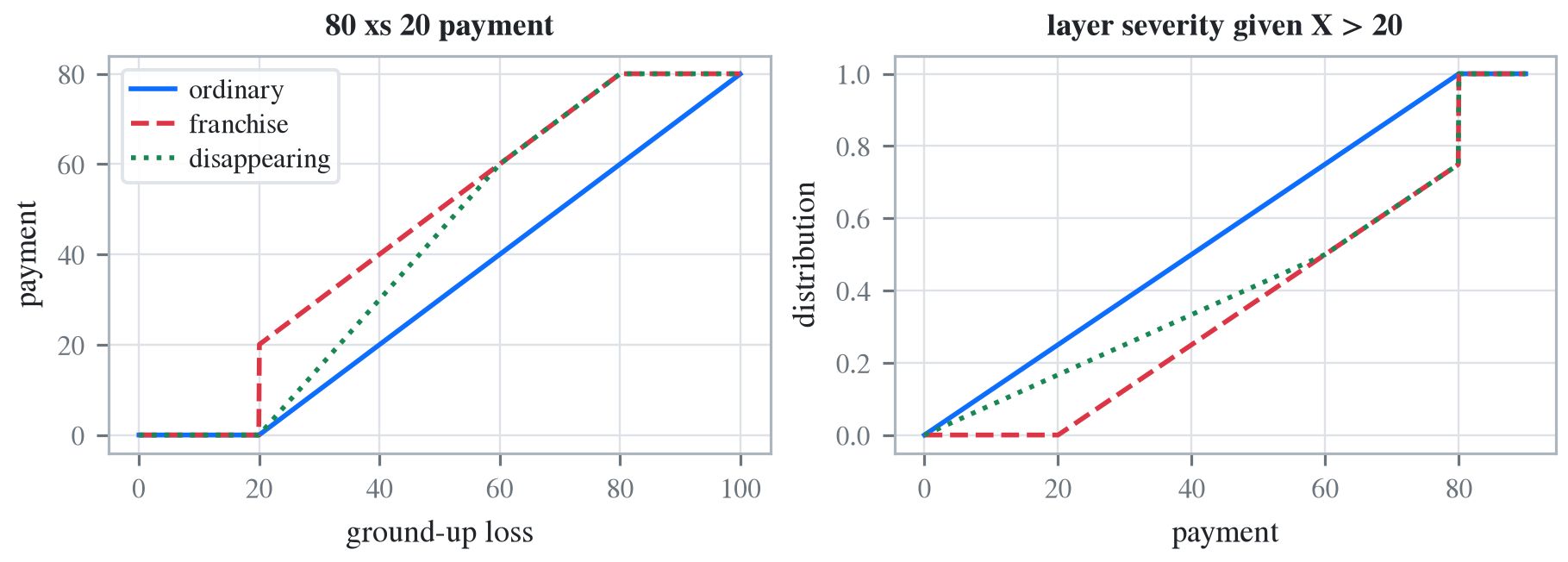
With a franchise deductible the layer pays nothing up to 20 and then the whole loss, so no payment lies in \((0, 20)\). With the disappearing deductible it pays \(1.5(x - 20)\) up to 60 and then the whole loss, the same as the franchise above 60. Both reach the limit at a loss of 80, the layer’s detachment, and put mass \(1/4\) on it; the ordinary layer reaches the limit only at 100.
for k, a in books.items():
    s = a.sevs[0]
    print(f'{k:13s} detachment {s.detachment:4.0f}   '
          f'mass at the limit {s.sf(79.999):.4f}')
Ordinary detachment 100 mass at the limit 0.0000
Franchise detachment 80 mass at the limit 0.2500
Disappearing detachment 80 mass at the limit 0.2500The hand calculation of the layer means starts from the loss uniform on \([0, 100]\), which given \(X > 20\) is uniform on \((20, 100)\). The ordinary layer pays \(X - 20\), uniform on \((0, 80)\), mean 40. The franchise layer pays \(X\) up to 80 and 80 above, mean \(\int_{20}^{80} x\,dx/80 + 80/4 = 57.5\). The disappearing deductible layer has mean \(\int_{20}^{60} 1.5(x - 20)\,dx/80 + \int_{60}^{80} x\,dx/80 + 20 = 15 + 17.5 + 20 = 52.5\). The ground-up means are \(\Pr(X > 20) = 0.8\) times the layer means: 32, 46, and 42.
hand = {'Ordinary': 40, 'Franchise': 57.5, 'Disappearing': 52.5}
df = pd.DataFrame.from_dict(
    {k: [hand[k], a.sevs[0].moms()[0], a.est_sev_m,
         ground_up[k].sevs[0].moms()[0], a.est_m] for k, a in books.items()},
    orient='index',
    columns=['hand', 'layer mean', 'grid mean', 'ground up', 'aggregate'])
df.index.name = 'deductible'
GT(df)| deductible | hand | layer mean | grid mean | ground up | aggregate |
|---|---|---|---|---|---|
| Ordinary | 40.0000 | 40.0000 | 40.0000 | 32.0000 | 400.0000 |
| Franchise | 57.5000 | 57.5000 | 57.5000 | 46.0000 | 575.0000 |
| Disappearing | 52.5000 | 52.5000 | 52.5000 | 42.0000 | 525.0000 |
The layer mean is exact, from the same partial expectations as an ordinary layer; the grid mean is that of the discretized severity, on a bucket of \(1/16\). The aggregate mean is ten times the layer mean.
In a vector of layers, to [...] takes one retention end per layer, and a scalar to d2 applies to every layer. The first layer below, 40 xs 10 to 30 disappearing, pays \(1.5(x - 10)\) on \((10, 30]\) and then \(\min(x, 40)\), with mean 33.89 given \(X > 10\).
v = build('agg Vector 10 claims [40 80] xs [10 20] to [30 60] disappearing '
          'sev 100 * uniform poisson')
for s in v.sevs:
    print(s.tail_description, f'mean {s.moms()[0]:.4f}')
uniform, [0, 40], bounded; 40 xs 10 to 30 disappearing mean 33.8889
uniform, [0, 80], bounded; 80 xs 20 to 60 disappearing mean 52.5000For a disappearing deductible the retention end must be at least the attachment, and a vector to must have one entry per layer. A franchise takes no to, since its retention end is the attachment, so to 60 franchise is a parse error.
refuse(*[p + ' sev 100 * uniform poisson' for p in [
    'agg D 10 claims 80 xs 20 to 10 disappearing',
    'agg D 10 claims [40 80] xs [10 20] to [30 60 90] disappearing',
    'agg D 10 claims 80 xs 20 to 60 franchise']])
Retention end 10 must be at least the attachment 20.
disappearing deductible: to [...] has 3 entries but there are 2 layers; give one
retention end per layer, or a single value for all of them.
DecL parse error at line 1, column 32: Unexpected 'franchise'.